
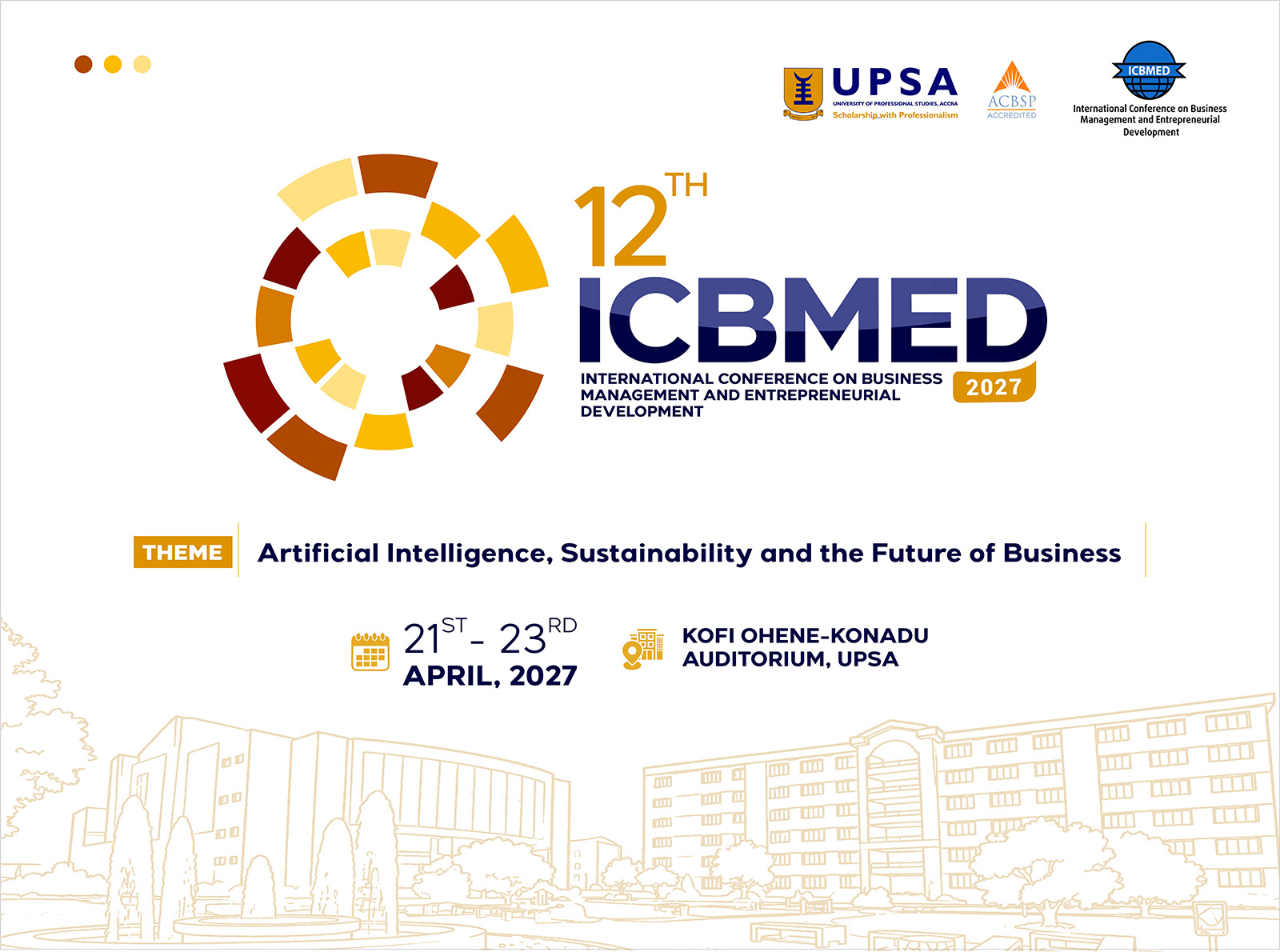
12TH INTERNATIONAL CONFERENCE ON BUSINESS MANAGEMENT AND ENTREPRENEURIAL DEVELOPMENT (ICBMED 2027)
21st -23rd April, 2027
Theme: Artificial Intelligence, Sustainability and the Future of Business
Artificial intelligence (AI) is transforming production systems, service delivery, financial intermediation, and decision‑making across industries. At the same time, sustainability pressures from climate change to resource constraints and evolving regulatory frameworks are compelling businesses to adopt greener, more resilient, and socially responsible strategies. Understanding how these forces interact is essential for shaping the future of business competitiveness, institutional effectiveness, and inclusive development.
The 12th International Conference on Business Management and Entrepreneurial Development (ICBMED 2027) provides an interdisciplinary platform for academics, researchers, industry practitioners, policymakers, professionals and postgraduate students to examine how artificial intelligence and sustainability are reshaping business, economics, law, humanities and communication, information technology, and related fields. The conference will feature keynote speakers, expert panels, doctoral colloquia, and practitioner roundtables.
ICBMED 2027 welcomes full or work-in-progress conceptual, empirical, methodological, and policy‑oriented papers that explore the intersections of AI, sustainability, and business transformation. All submissions will undergo double‑blind peer review, and accepted papers will be considered for presentation in the following tracks or sub-themes.
Track 1: AI, Innovation and Sustainable Business
- Artificial intelligence and business transformation
- Entrepreneurship, innovation and technopreneurship
- Strategic management and organisational transformation
- AI-enabled marketing, consumer behaviour and customer experience
- Human resource management, leadership and the future of work
- Corporate sustainability, ESG and responsible business
- Green and circular business models
- Sustainable supply chains, logistics and operations
- Hospitality, tourism and service innovation
- Food, agribusiness, nutrition enterprises and sustainable food systems
- SMEs, family businesses and digital transformation
- Social enterprise and inclusive business
Track 2: AI, Economics, Finance, Real Estate and Sustainable Development
- AI, productivity, economic growth and labour-market transformation
- Digital trade, AfCFTA and international business
- Sustainable finance, green finance and ESG investment
- FinTech, banking, insurance and financial inclusion
- Accounting, auditing and taxation in the digital economy
- Real estate, property markets and sustainable housing
- PropTech, smart buildings and digital property management
- Urban development, infrastructure and sustainable cities
- Climate economics and the green transition
- Poverty, inequality and inclusive economic development
- Informal economies and digitalisation
- AI, public finance and the Sustainable Development Goals
Track 3: AI, Law, Governance, Ethics and Public Policy
- AI regulation and emerging legal frameworks
- Responsible and ethical artificial intelligence
- Data protection, privacy and cybersecurity law
- Intellectual property, AI-generated content and copyright
- Competition law, digital platforms and consumer protection
- Labour law, platform work and employment regulation
- Corporate governance, accountability and transparency
- Human rights and artificial intelligence
- Environmental law and sustainability governance
- Digital evidence, justice and legal technology
- Public-sector governance and digital transformation
- Technology policy and regulatory innovation
Track 4: AI, Humanities, Communication, Media and Society
- AI and strategic communication
- Journalism, media transformation and generative AI
- Public relations, corporate communication and reputation management
- Advertising, branding and digital communication
- Misinformation, disinformation and synthetic media
- AI, language, culture and identity
- Digital storytelling and the creative industries
- Communication for sustainable development
- Humanities in the digital age
- Culture, heritage and sustainable development
- Behavioural, social and ethical implications of AI
- Diversity, inclusion and digital participation
Track 5: AI, Information Technology and Sustainable Digital Futures
- Artificial intelligence, machine learning and generative AI
- Business analytics, big data and decision-support systems
- Digital transformation and enterprise systems
- Cloud computing and digital infrastructure
- Cybersecurity and cyber resilience
- Internet of Things and smart systems
- Blockchain and distributed technologies
- Green computing and energy-efficient technologies
- Smart cities and sustainable digital infrastructure
- AI applications in agriculture, health and education
- Human-computer interaction
- Responsible data management and digital ethics
- Digital inclusion and the digital divide
- Emerging technologies and the future of business
Track 6: AI, Sustainable Education and Future of Business Skills
- AI-enabled teaching, learning, and assessment
- Curriculum innovation in education and professional training
- Sustainable education models for inclusive human capital development
- Green skills, climate literacy, and competencies for sustainable business
- Sustainable campuses, green curricula, and climate education
- Equity, access, and the digital divide in education
- AI-supported lifelong learning, reskilling, and workforce transition
- Ethical, inclusive, and responsible uses of AI in education
- Industry–academia partnerships for employability, entrepreneurship, and innovation
- Education policy, quality assurance, and investment for digital transformation
Submission Guidelines
Authors are invited to submit a detailed abstract of 400-500 words or full paper of 1,000-1,500 words. The submission should provide sufficient information for the Scientific Committee to assess the quality, relevance, rigour and contribution of the proposed paper.
1. Title: A clear and specific title, preferably not more than 20 words.
2. Background and Context: Briefly introduce the subject, its relevance and the problem being addressed.
3. Research Problem or Gap: State clearly what is not sufficiently known, addressed or explained in existing research or practice.
4. Aim, Objectives or Research Questions: State the main purpose of the study and the key objective(s) or research question(s).
5. Theoretical or Conceptual Foundation: Identify the principal theory, framework or analytical perspective, where applicable.
6. Methodology: State the research design, setting, population/sample, data-collection approach and principal method of analysis. Conceptual or policy papers should explain the review or analytical approach used.
7. Key Findings or Expected Findings: For completed studies, present the principal findings. For ongoing studies, state the expected findings or anticipated contribution clearly.
8. Contribution and Novelty: Explain what is new and how the paper advances theory, evidence, policy, practice, technology or sustainability.
9. Practical, Policy and/or Sustainability Implications: Briefly indicate the relevance of the study to managers, policymakers, regulators, communities, professionals or sustainable development.
10. Keywords: Provide 4-6 keywords.
Submission Requirements
- Detailed abstract length: 400-500 words (excluding references)
- Full paper length: 1,000-1,500 words (excluding references)
- Language: English
- Font: Times New Roman, 12 point
- Line spacing: 1.5
- Alignment: Justified
- Keywords: 4-6
- References: APA 7th edition; only essential references should be included
- File format: Microsoft Word (.docx)
- Tables/Figures: Maximum of one, only where essential
- Conference track: Authors must indicate the most relevant ICBMED 2027 thematic area
Submission Process
- Submit your papers through the ICMBED online submission portal
- Upload two documents in Word format ((document without author details and document with author details)
Important Dates
- Announcement of Call for Papers – 5th October, 2026
- Abstract Submission Deadline – 15th January, 2027
- Notification of Abstract Acceptance – 22nd January, 2027
- Full Paper Submission Deadline – 15th February, 2027
- Notification of Full Paper Acceptance – 22nd February, 2027;
- Doctoral Workshop – 21st April, 2027
- Conference – 22nd – 23rd April, 2027
Conference Registration and Participation
- At least One Author of each accepted paper must register and present at the conference.
- The registration fee is as follows:
- Local Participants:
- Students – GH¢300.00
- Others (including faculty) – GH¢600.00
- International Participants
- Students – US$50.00
- Others – US$100.00
- Registration fee covers conference proceedings, access to conference activities, and conference meals;
- Accommodation is NOT included in conference registration.
Publication Opportunities
- Accepted papers will be considered for:
- Conference proceedings
- Special issues in partner journals
- Journal of Business and Professional Studies
- Journal of Management and Sustainability
- Journal of Economics, Accounting and Finance
- Journal of Information Systems and Computer Science
- Journal of Language
- Edited book volumes