
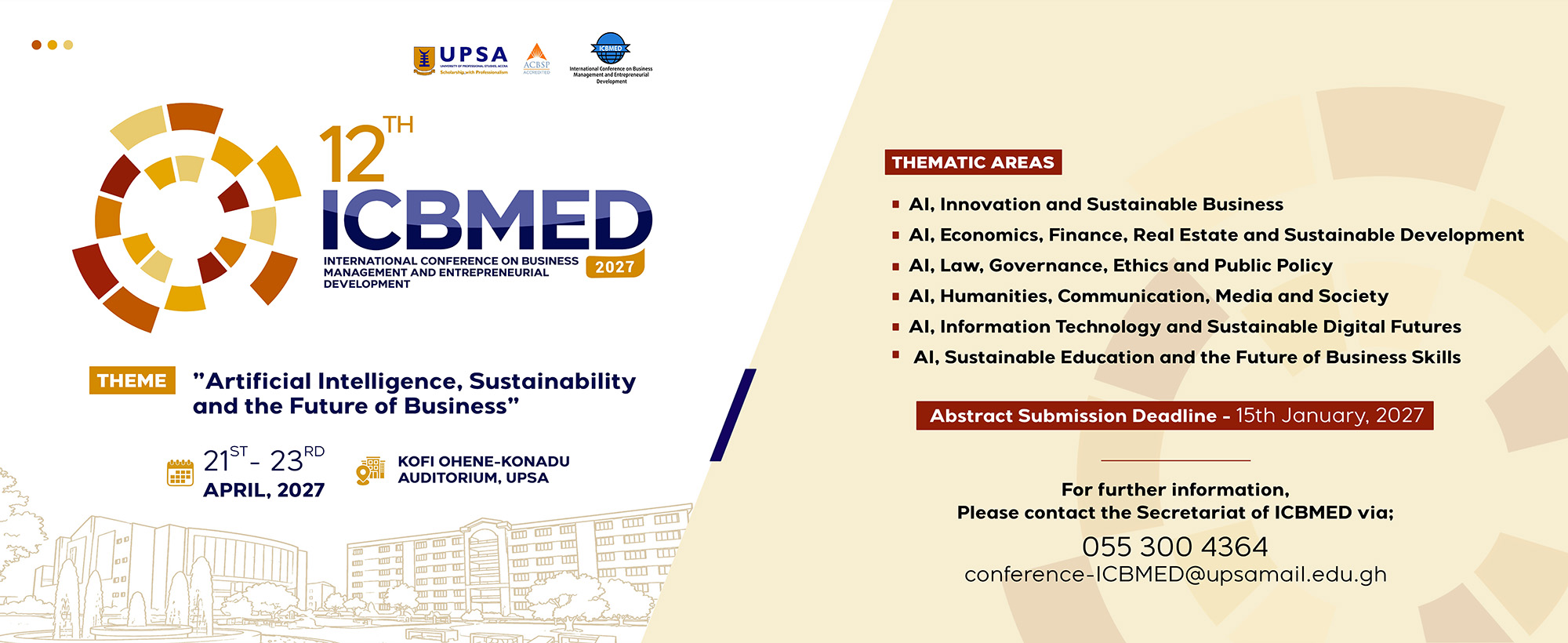
12th ICBMED
The 12th International Conference on Business Management and Entrepreneurial Development (ICBMED 2027) provides an interdisciplinary platform for academics, researchers, industry practitioners, policymakers, professionals and postgraduate students to examine how artificial intelligence and sustainability are reshaping business, economics, law, humanities and communication, information technology, and related fields. The conference will feature keynote speakers, expert panels, doctoral colloquia, and practitioner roundtables.
ICBMED 2027 welcomes full or work-in-progress conceptual, empirical, methodological, and policy oriented papers that explore the intersections of AI, sustainability, and business transformation. All submissions will undergo double blind peer review, and accepted papers will be considered for presentation in the following tracks or sub-themes.
- Track 01
AI, Innovation and Sustainable Business
• Artificial intelligence and business transformation
• Entrepreneurship, innovation and technopreneurship
• Strategic management and organisational transformation
• AI-enabled marketing, consumer behaviour and customer experience
• Human resource management, leadership and the future of work
• Corporate sustainability, ESG and responsible business
• Green and circular business models
• Sustainable supply chains, logistics and operations
• Hospitality, tourism and service innovation
• Food, agribusiness, nutrition enterprises and sustainable food systems
• SMEs, family businesses and digital transformation
• Social enterprise and inclusive business - Track 02
AI, Economics, Finance, Real Estate and Sustainable Development
• AI, productivity, economic growth and labour-market transformation
• Digital trade, AfCFTA and international business
• Sustainable finance, green finance and ESG investment
• FinTech, banking, insurance and financial inclusion
• Accounting, auditing and taxation in the digital economy
• Real estate, property markets and sustainable housing
• PropTech, smart buildings and digital property management
• Urban development, infrastructure and sustainable cities
• Climate economics and the green transition
• Poverty, inequality and inclusive economic development
• Informal economies and digitalisation
• AI, public finance and the Sustainable Development Goals - Track 03
AI, Law, Governance, Ethics and Public Policy
• AI regulation and emerging legal frameworks
• Responsible and ethical artificial intelligence
• Data protection, privacy and cybersecurity law
• Intellectual property, AI-generated content and copyright
• Competition law, digital platforms and consumer protection
• Labour law, platform work and employment regulation
• Corporate governance, accountability and transparency
• Human rights and artificial intelligence
• Environmental law and sustainability governance
• Digital evidence, justice and legal technology
• Public-sector governance and digital transformation
• Technology policy and regulatory innovation - Track 04
AI, Humanities, Communication, Media and Society
• AI and strategic communication
• Journalism, media transformation and generative AI
• Public relations, corporate communication and reputation management
• Advertising, branding and digital communication
• Misinformation, disinformation and synthetic media
• AI, language, culture and identity
• Digital storytelling and the creative industries
• Communication for sustainable development
• Humanities in the digital age
• Culture, heritage and sustainable development
• Behavioural, social and ethical implications of AI
• Diversity, inclusion and digital participation - Track 05
AI, Information Technology and Sustainable Digital Futures
• Artificial intelligence, machine learning and generative AI
• Business analytics, big data and decision-support systems
• Digital transformation and enterprise systems
• Cloud computing and digital infrastructure
• Cybersecurity and cyber resilience
• Internet of Things and smart systems
• Blockchain and distributed technologies
• Green computing and energy-efficient technologies
• Smart cities and sustainable digital infrastructure
• AI applications in agriculture, health and education
• Human-computer interaction
• Responsible data management and digital ethics
• Digital inclusion and the digital divide
• Emerging technologies and the future of business - Track 06
AI, Sustainable Education and Future of Business Skills
• AI-enabled teaching, learning, and assessment
• Curriculum innovation in education and professional training
• Sustainable education models for inclusive human capital development
• Green skills, climate literacy, and competencies for sustainable business
• Sustainable campuses, green curricula, and climate education
• Equity, access, and the digital divide in education
• AI-supported lifelong learning, reskilling, and workforce transition
• Ethical, inclusive, and responsible uses of AI in education
• Industry–academia partnerships for employability, entrepreneurship, and innovation
• Education policy, quality assurance, and investment for digital transformation